
2026 Symposium Registration is Open!
PHOTOGRAPHY NETWORK presentsVision and Veiling:
Photographic Resilience and Sociopolitical Change
November 5 – 7, 2026(ONLINE)
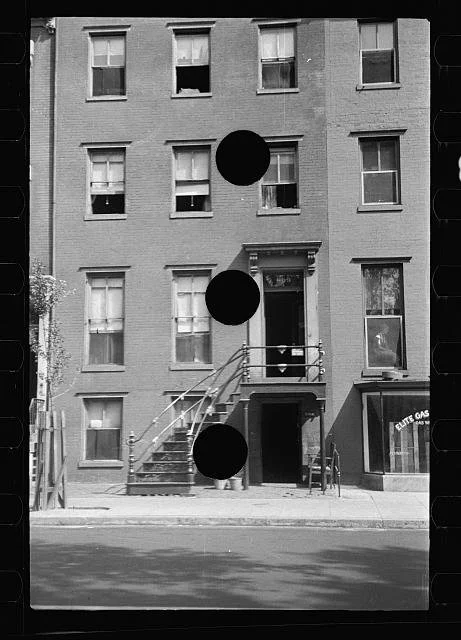
Three holes have been punched through the 35 mm. Library of Congress, Prints & Photographs Division, FSA/OWI Collection, [LC-USF33-T01-000260-M3]Photography Network’s sixth annual symposium offers a platform for scholarship that investigates the adaptability of photography and photo history in the face of constraints, be they cultural, governmental, institutional, editorial, individual, or otherwise.
What do historians, curators, and photographers do when limitations are placed on their work, and what do the limitations themselves reveal about photography? Relatedly, when is restriction, refusal, or withdrawal protective, strategic, or empowering? Finally, what, if anything, has changed about how the medium navigates social or cultural boundaries—what can we learn from how practitioners have done this in the past that might shed light on present-day questions?
Thursday, November 5
-
“The Unsettled Photo Archive: Censorship, Decolonial Praxis, and the Limits of Visual Sovereignty”
This talk examines the contemporary decolonisation of photographic archives as a contested site where historical redress, ethical responsibility, and the politics of visibility converge. It argues that, while confronting the epistemic and representational violence embedded in colonial photographic collections is essential, decolonial interventions can also raise difficult questions about restriction, withdrawal, access, and authority. When photographs are removed from circulation, made inaccessible, or subjected to controlled visibility in the name of care, justice, and visual sovereignty, they can generate forms of exclusion that complicate the emancipatory aims of archival decolonisation. The talk therefore proposes reconsidering censorship not simply as overt prohibition, but as a broader process through which visibility, access, interpretation, and legitimacy are organised. It briefly revisits expanded approaches to censorship, drawing on scholarship that understands it as diffuse, relational, internalised, and productive (even when its effects are unintended or undesirable), before bringing these perspectives to bear on the decolonisation of colonial-era photographic archives. In doing so, the talk considers how practices of withdrawal, restriction, concealment, contextualisation, and controlled access reshape the status and afterlife of photographs, while redistributing authority over who may see, interpret, reproduce, and engage with them. Rather than treating these tensions as a failure of decolonial praxis, the talk approaches them as sites of necessary reflexive critique. Examples are deliberately avoided, both to resist singling out particular initiatives and to acknowledge that decolonial interventions, however well-intentioned, may produce unintended or harmful effects. Instead, the discussion critically examines prominent approaches to the decolonisation of institutional collections, specifically, comprising photographic imagery produced within, through, or in relation to imperial and colonial formations. The talk ultimately advocates for an approach to archival decolonisation—and to archival decentralisation more broadly—that confronts historical harm and entrenched structures of power without foreclosing plurality, openness, or critical engagement.
Gil Pasternak is Professor of Photographic Cultures and Heritage at De Montfort University (UK), where he is Director of the Photographic History Research Centre (PHRC) and Interim Research and Innovation Director of the Institute of Arts, Design and Performance. He is also Europe and UK Editor for Photography & Culture and serves on the advisory boards of cultural heritage and visual culture organisations, including the Apna Heritage Archive (UK), Derby Yaadaañ Archive at Derby Museums (UK), and ARCHIVO: Photography and Visual Culture Research Platform (Portugal). Pasternak’s research explores intersections of photography, cultural heritage and political formations, with particular attention to domestic photography, community archives, migration, and cultural conflict. He edited The Handbook of Photography Studies (Routledge 2020), bringing together interdisciplinary approaches to the study of photography, and has led major international and national projects, including the European Commission-funded Digital Heritage in Cultural Conflicts and the UKRI-funded Picturing Untold Migration Experiences. His current work includes a monograph on domestic photographs and their political incorporation into digital heritage initiatives, and two forthcoming co-edited volumes on censorship and visual culture, exploring the complex reciprocal relationship between visual practices, political power, and socio-cultural transformation.
Symposium Introduction (12:00 pm EST)
PN Symposium Liaison
Welcome Remarks
PN Co-Chair
Announcement of Book Awards and Project Grants
PN Awards Coordinator
Meet and Greet (12:30–1:00 pm EST)
All registrants welcome
Keynote (1:00 pm EST)
Gil Pasternak
Friday, November 6
Panel 1
"Artistic Practices of Strategic Veiling and Unveiling”
10:00-11:30 am EST
-
The Algorithmic Veil: Archival Refusal and ESEA Diasporic Memory in Nhu Xuan Hua’s Tropism
This paper investigates the tension between photographic visibility and historical erasure within East and Southeast Asian (ESEA) diasporic narratives, focusing on Nhu Xuan Hua’s exhibition Tropism: Consequences of a Displaced Memory. Responding to the symposium’s core investigation into strategic withdrawal and photographic resilience, it examines how Hua manipulates her family’s archival photographs from Vietnam. Through digital interventions that stretch, blur, and dissolve the physical forms of her ancestors, Hua transforms clear family snapshots into uncanny, altered landscapes where figures are systematically obscured by digital distortions and flora.
Rather than viewing these digital interventions as a loss of data, this paper utilises Tina Campt’s theory of the 'visual frequency' of the archive and Saidiya Hartman’s concept of 'critical fabulation' to frame Hua’s interventions as active interventions of archival refusal. In the context of displacement and geopolitical trauma, the family album is frequently subjected to exoticising or state-sanctioned gazes. Hua’s aesthetic 'veiling' operates as a protective gesture - withdrawing the vulnerable body of the migrant from the complete consumption of the Western or colonial eye.
In conclusion, this presentation contends that photographic resilience does not always manifest as a demand for unmediated representation. Instead, Hua demonstrates that in the wake of historical displacement, a practitioner's power can lie in the deliberate generation of opacity. By veiling her subjects, Hua protects the integrity of personal trauma, positioning the digital glitch not as a technical failure, but as a sovereign space of diasporic refusal.
-
Alvin Baltrop's Waterfront Opacities
Between 1975 and 1986, American photographer Alvin Baltrop (1948–2004) documented Manhattan's abandoned West Side piers, where gay men cruised for sex in the ruins of New York's deindustrialized waterfront. Working in an era of intense surveillance — by police deploying decoys and hidden cameras, by celebrated, predatory artists such as Robert Mapplethorpe, and by homophobic elements within African-American communities — Baltrop developed a counter-strategy rooted in deliberate concealment. He placed subjects at extreme distances, allowed obstructions to interrupt sightlines, and used dramatic over- and underexposure to dissolve identifying features. In the darkroom, he extended these operations further, producing what this paper calls a "deliberately incomplete archive." Drawing on Édouard Glissant's theory of opacity — the right of subjugated peoples to remain irreducible to the scrutinizing gaze — this paper argues that Baltrop's formal obfuscations were not technical failures but ethical accomplishments. The darkness the piers were known for, and which many cruisers described in terms of democratic liberation, became Baltrop's primary aesthetic resource. His photographs refused transparency without retreating into invisibility, occupying instead the productive middle ground Glissant identified as opacity. In doing so, Baltrop anticipated questions that feel urgently contemporary: when is photographic withholding an act of protection rather than omission? When does veiling serve the subject rather than the institution? And what does it mean to practice documentary photography in the service of a community's right to remain unseen?
Myles Little, PhD, is a teacher, curator, and photo editor.
-
From Covert Sense to Incipient Utterance: Edmund Teske’s Queer Photographic Abstractions
In 1958, the photographer Edmund Teske formalized a darkroom technique known as ‘duotone solarization.’ Unlike more familiar forms of solarization, this process transformed the photographic print’s lightest tones into high densities of bronze-colored image material. The resulting artworks undid conventional distinctions between black-and-white photography and its color counterpart, while collapsing the poles of the medium’s tonal range. In troubling these binaries, the photographs tacitly challenged those polarities that govern certain social categories, too. Prior to his embrace of duotone solarization, Teske had seeded his photographs with a coded iconography that voiced an outlook at odds with Cold War-era gender and sexual mores. Armed with his novel darkroom technique, he modified his approach: giving direct form to a queer ontology via photographic materiality.
Both aesthetic strategies—iconographic and material—were likewise survival strategies, forged amid the twinned moral panics of McCarthyism and the Lavender Scare. Moving from the former to the latter marked a radical pivot in Teske’s practice away from covert expressions of nonconformity toward an unforming of legibility altogether. The proposed paper frames the artist’s duotone solarizations as a mode of queer abstraction, a category elucidated by scholars like Jonathan Katz and David Getsy. Situating Teske’s photography within postwar Los Angeles’s gay and countercultural circles, and in relation to his peers’ abstract films and assemblage works, the paper identifies a retreat from sense into the not-yet-articulated as a privileged mode of philosophical investigation and collective worldbuilding for Teske and his fellow West Coast artists living at the margins of American society.
Samuel Allen is a PhD candidate at New York University's Institute of Fine Arts and curatorial assistant in the Department of Photography at The Museum of Modern Art, New York.
Panel 2
"Repressive Governments and Photographic Persistence”
12:00-1:45 pm EST
-
From Censorship to Containment: Photography Exhibitions and Strategies of Resilience in Turkey, 2000–2023
Over the last two decades, censorship affecting photography exhibitions in Turkey has shifted from direct political and military intervention toward more decentralized forms of administrative, corporate, algorithmic, and social control. This paper examines that transformation through a series of institutional case studies spanning from 2000 to 2023, focusing on how photographers, curators, and cultural organizations have responded to changing conditions of visibility and restriction.
The presentation explores how “red lines” have been constructed around political opposition, Kurdish identity, LGBT+ representation, and religious sensitivities. Rather than banning images outright, contemporary censorship increasingly operates through selective practices of veiling that restrict circulation, sponsorship, institutional support, and public access while often leaving the image itself intact.
Drawing on examples ranging from the 2002 National Geographic/İFSAK Afghanistan text dispute to the withdrawal of the 2023 exhibition İmroz’un 1964 Belleği, the paper traces the evolution of censorship mechanisms from direct intervention to administrative containment, sponsorship pressure, social media targeting campaigns, and bureaucratic vetting. These cases reveal how exhibition spaces have become contested sites where visibility is negotiated among state institutions, private actors, cultural organizations, and networked publics.
The paper also examines strategies of resilience developed in response to these pressures, including the 2002 double-tiered “sandwich hanging” at the Press Museum, the use of symbolic black voids to mark censored absences, institutional boycotts, and the migration of restricted projects to autonomous digital platforms.
The Turkish case reveals a broader transition from direct coercion to dispersed forms of containment while demonstrating how photographic practitioners continue to develop new forms of curatorial, institutional, and visual resilience.
Ozan Yavuz is a photographer, researcher, and lecturer at Middle East Technical University whose work explores photography, visual culture, and emerging imaging technologies. His current research focuses on artificial intelligence, photographic knowledge, and the philosophical possibilities of rethinking photography beyond Western traditions.
-
“Paper Monuments”: Cityscape Magazine and the Remapping of Washington, D.C.
Outsiders often perceive Washington, D.C. as paradoxically iconic and placeless. This contradiction, African American studies scholar Brandi Thompson Summers has suggested, comes from a distinctly racialized perceptual division: “‘D.C.’ is Black and ‘Washington’ is white.” This paper mines the context of the 1976 Bicentennial as fertile ground for photographic reimaginings of Black Washington. I examine the student magazine Cityscape, produced by high school documentarians at the Duke Ellington School of the Arts. Students combined historical and new photographs, explored local geography through remembrances of older Washingtonians, and investigated contemporary activists and community groups. I argue that Cityscape students remapped the District by filling in gaps left by fractured and incomplete archives and sensationalized media representations. Appropriating the term “pictures generation” to refer to the vernacular practices of young people during the 1970s and ‘80s, this paper joins scholarship considering the 1970s as a flashpoint for documentary experimentation. Student photojournalism practices across the U.S. were not parroting existing media, but repurposing photography to convey new narratives about their communities. Cityscape was both bolstered and constrained by funding and associations with local and national networks. Supported by the D.C. Bicentennial Commission, local Neighborhood Planning Councils, and associated with the “Foxfire” model of student journalism, Cityscape plumbed the implications of celebrating the Bicentennial in Washington. Borrowing from Faye Gleisser’s concept of “punitive literacy,” I demonstrate how student documentarians smuggled in trenchant critiques of Bicentennial celebrations and expanded and complicated expected perceptions of the nation’s capital city during a time when D.C. residents lacked political representation as well as self-determined media representation.
Jesse Dritz is a PhD candidate in the American Studies Program at Boston University. She studies twentieth-century photography and material culture.
-
An image and its many publics: political restagings of Vladimir Herzog’s Staged Suicide Photograph under the Brazilian Civil-Military Dictatorship and Beyond
The Civil-Military Dictatorship (1964–1985) generated some of the most emblematic images in Brazilian political history. One of these is the photograph of journalist Vladimir Herzog hanging in a cell at DOI-CODI in São Paulo in an “impossible position” — with his feet, and almost his knees, touching the ground. Originally staged to absolve state agents involved in the journalist’s murder under torture, the suicide photograph was later resignified as its exact opposite: a symbol of state violence, mobilized in political claims against the dictatorship.
But how and why did this political transformation of the image take place? This research argues that the photograph’s ability both to reproduce and to dismantle the social order enacted by the military lies in its potential to mobilize publics—a potential realized only through the process of circulation. With this in mind, the research examines the history of the photograph’s distribution, seeking to trace the associations established among the multiple
political actors who engaged with it across three distinct moments: first, within the juridical sphere organized by the military, where it functioned as evidence both to acquit the regime and to terrorize its opponents; second, following its publication in the press, still during the dictatorship, where it mobilized political claims against the state while circumventing censorship; and third, in the aftermath of the dictatorship, when it became an icon around which disputes over the memorialization of the dictatorship crystallized.
João Felipe R. Ferreira is a researcher, cultural producer, and independent curator from Brazil, working at the intersection of art, human rights critique, and media theory. He holds an M.A. in Human Rights and the Arts from Bard College (2026) and is currently pursuing an M.A. in Media Studies at the State University of Campinas (Unicamp). He also holds a B.A. in Media Studies (2023) from the same university.
-
Clandestine Camera: Deep Politics and Photographic Intelligence
This paper traces the complex relationship between photographic intelligence gathering and the evolving landscape of the United States national security state. Focusing on the intersection of photoreconnaissance, intelligence operations, and governmental secrecy, I begin by looking to the early Cold War nuclear arms race, which led to significant advancements in photographic technology. Overhead photoreconnaissance conducted from spy planes and satellites fitted with high-resolution camera systems became the most successful method of gathering intelligence on Soviet weapons capabilities and military installations and has since become essential to maintenance of US global dominance.
While conventional accounts of overhead reconnaissance development emphasize technological innovation and military strategy, this investigation connects aerial and satellite imaging systems to networks of covert action, elite power, and secrecy. Photographic intelligence gathering has intersected with foreign intervention, propaganda, and domestic political scandals. Through discussion of powerful institutional figures and the formation of the modern US intelligence apparatus, I outline the political milieu in which reconnaissance technologies were developed and demonstrate how photographic evidence can be mobilized, concealed, or selectively revealed in support of political objectives.
Photoreconnaissance and other intelligence operations produce classified images that I refer to as "deep photography." The term is inspired by Peter Dale Scott's concept of deep politics: “all those political practices and arrangements, deliberate or not, which are usually repressed rather than acknowledged.” Defining deep photography as photographic intelligence that is classified, redacted, destroyed, or leaked, I argue that photographic operations and technologies have been central to not only to intelligence gathering but the production and regulation of political knowledge.
Evan Hume is an artist educator based in Ames, Iowa, where he is assistant professor of photography at Iowa State University. He has published two photography monographs with Daylight Books: Viewing Distance (2021) and Critical Collection (2025).
Artist Dialogue
2:00-3:00 pm EST
Moderator:
Mtume Gant
-
This session centers on Martyrdom and The Museum: The Political Economy of Photography, an essay examining how photographs of racial violence acquire new meanings as they move through archives, museums, classrooms, social media, and works of art. Beginning with artist Zora J Murff’s decision to withdraw from the Museum of Contemporary Photography’s exhibition If Emmett Till Lived, the discussion asks under what conditions representations of violence expose power and when they instead become resources for extraction.
Framed as a public conversation rather than a formal lecture, Murff will be joined by artist, theorist, and educator, Jabari Zuberi. Together they will explore the essay’s central concepts, including the political economy of photography, the production of public memory, the social relations that shape what images come to mean, what forms of value they generate, and whose interests they ultimately serve.
Using the photographs of Emmett Till’s funeral as a central case study, the conversation will consider how images move from documentary evidence and instruments of political organizing to historical artifacts, museum objects, and various recurring sources for cultural production. This session isn’t meant to offer definitive answers; it is intended as an opportunity to collectively struggle over difficult questions concerning representation, power, and the ethical and political functions of photography. Audience participation will be encouraged throughout, creating space for critical dialogue that extends beyond the paper itself and into broader debates about photography’s role in shaping public life. Attendees are encouraged to read the essay prior to attendance, and is available here: https://cityboyzora.substack.com/
Zora J Murff is an artist and educator based in Oregon. Other facts about him include: he practices art to support consciousness-raising and to engage in intellectual struggle. The industry compatible objects he makes often–but not always–relate to the violent paradoxes and perils created by an imperial paradigm.
Jabari Zuberi is an artist, theorist, educator, and cultural leader whose work bridges artistic practice, writing, education, and institutional leadership. He holds an MFA in Photography from the Rhode Island School of Design, a Master of Liberal Arts focusing on visual anthropology from the University of Pennsylvania, and a BFA in Photography from Columbia College Chicago.
Saturday, November 7
Panel 3
"Commercial Subversion”
10:00-11:30 am EST
-
A Photographic Amusement Can Mean Serious Business: On Lotte Jacobi’s Subterfuges in Response to the Aryanization of German Photography (1933-1935)
How did German-Jewish photographer Lotte Jacobi who was heir to the prominent, prosperous, and multi-generational Berlin photographic studio Atelier Jacobi respond and adapt to the Nazi’s political takeover, their program to “Aryanize” photography, and state-sanctioned anti-Semitic persecution in the early years of the Third Reich? This presentation reviews the attempts of Lotte and her father Sigismund to find a way to stay in operation with new non-Jewish business partners functioning as fronts and culminating in the selection of Alexander Bender in October 1934. This leads to a consideration of the interpersonal relations among Jacobi, Bender, and the famous actor Anton Walbrook who was Bender’s close friend and personal secretary. Ironically, this plan fell apart when a Jewish ancestor was found in Bender’s genealogy the next year rendering him just as “non-Aryan” under tightening Nazi controls. The centerpiece of this analysis will be an allegorical and unique Janus-faced portrait of the actor taken in 1933 which is not only a successful formal experiment in double exposure (and doubling) and a wonderful example of Jewish photographic wit but also a mirror of the deceptions and subterfuges undertaken by these three figures as they sought to hide or mask their Jewish roots and queer associations from Nazi authorities during those repressively “dark times.” This case study demonstrates how a photographic amusement can mean serious business foregrounding the possibilities and limits of photographic resilience to sociopolitical change and deploying veiling strategies that ultimately failed with Jacobi leaving for New York in September 1935.
Louis Kaplan is Director of Graduate Studies in the Department of Art History at the University of Toronto where he is Professor of History and Theory of Photography and New Media. He is currently working on a full-length study dealing with “Jewish Photographic Humor in Dark Times” that analyzes a constellation of photographers and their dark humorous responses at the start of the Third Reich.
-
“For the Price of a Bullet”: Photography and the Politics of Peace in 1930s France
On the occasion of the February 1932 World Disarmament Conference, organized by the League of Nations in Geneva, the designer Jean Carlu enlisted the photographer André Vigneau to produce anti-war posters that would “sell the idea of peace” to a mass public. When their collaborative Pour le désarmement des nations (For the Disarmament of Nations; 1932) appeared in an exhibition of the Union des Artistes Modernes (UAM) at the Musée des Arts décoratifs in Paris, board members reportedly objected to Vigneau’s staged photograph of a mother shielding her child from a torpedo, said to possess the “gift of arousing the sensibilities” at an “untimely” moment. Their calls for its removal were initially successful, though it was subsequently reinstated. This frenzied episode of censure is emblematic of the broader constraints facing photographers who sought to mobilize images amid mounting geopolitical instability.
In this paper, I examine Vigneau’s attempts throughout the 1930s to align the visual language of modern advertising with the moral imperatives of pacifism and antifascism. After the affair at UAM, Vigneau began to use images of consumer goods and domestic comfort to stand in for the spectacle of combat, implicitly framing war as a threat to the material well-being of middle-class Parisians. This strategy enabled his projects to circulate within sanctioned state and institutional spaces, avoiding further censure. However, his methods also presage the political contradictions inherent in post-war humanism, which I argue raises critical questions about the possibilities and limits of the interwar period’s engaged photography.
Caitlin Ryan is Assistant Curator of Photography at The Museum of Modern Art. She holds a Ph.D. in Art & Archaeology from Princeton University.
-
When the Backdrop Speaks Without the Painter: Signature Erasure and Visual Rhetoric in Cameroonian Studio Photography
This paper examines the deliberate removal of artists’ signatures from painted studio backdrops by second-generation photographers in Cameroon. Drawing on fieldwork in a bicultural context, it argues that signature erasure operated as a strategic restriction in which photographers obscured authorship to prevent competitors from tracing backdrop painters and reproducing highly popular designs that attracted clients. While economically protective, this act of withdrawal also produced a form of cultural erasure, limiting the circulation of motifs tied to specific cultural groups and disrupting the visual record and rhetorics of artistic labour. The practice reveals how photographic objects become sites where economic competition, cultural visibility, and historical authorship are negotiated. Situating this case within broader debates on photographic removal and concealment, the paper shows how small material interventions such as erasing a signature reshape the cultural ecology of studio photography and complicate future archival, historical, and curatorial work.
Valentine Nyamndon is a photographic historian and visual anthropologist, access mediator, and researcher in the creative environment, darkroom, photography, archives, broadcast, dance, and Music studio at the University of Nottingham. He holds a PhD in Photographic History and Visual Culture from the Photographic History Research Center at De Montfort University.
Panel 4
"Archives and the Impact of Seeing”
11:45-1:30 pm EST
-
Beyond Viewing: Concentration Camps and the Ethics of Interpretation in Thérèse Bonney’s Photography
What are the ethical implications of producing interpretive scholarship on concentration camp imagery? Photographs of camps frequently function as evidentiary objects, yet they are also mediated forms shaped by censorship, editorial intervention, archival selection, and shifting regimes of visibility. This paper examines these tensions through the wartime photography of Thérèse Bonney (1894–1978), arguing that the challenges of interpreting camp photographs reveal broader questions concerning photography’s relationship to historical knowledge and the representational obligations embedded within scholarly interpretation itself.
Drawn from my book project, this paper focuses on Bonney’s documentation of camps including Buchenwald and Dachau, alongside lesser-studied internment and labor camps such as Rivesaltes and Vaihingen-an-der-Enz. Apart from photographs of children held in internment camps, Bonney appears never to have published the nearly 400 camp photographs she produced while working for the U.S. and French governments. Today, however, these images are digitally available and newly recirculated.
My concern centers not on the ethics of viewing—which has already occurred—but on the ethics of interpretation itself: in what capacity should such images be analyzed, reproduced, or strategically withheld? Having identified children through tattooed numbers and reconstructed names absent from the archive, I ask what obligations accompany acts of recovery and naming. Building on scholars such as Robert Ehrenreich and Daniel Magilow, I consider how Bonney’s acts of concealment—and now my own—structure historical understanding. Rather than treating obscurity as absence, I argue that photographic instability reveals the ethical conditions through which camp imagery acquires historical meaning.
Caroline M. Riley is a Research Associate at the University of California, Davis, specializing in American art, photography, museums, and transnational visual culture. She is the author of MoMA Goes to Paris in 1938 (UC Press, 2023) and is completing Thérèse Bonney and the Power of Global Syndicated Photography, under contract with UC Press.
-
Veiled Looks: Clandestine Photography and the Resilience of Working-Class Vision in Reggio Emilia, Late 1950s–Early 1970s
In the textile factories of Reggio Emilia between the late 1950s and the early 1970s, women workers made photographs clandestinely: images taken in secret on the shop floor, concealed from managerial and even union oversight, and kept outside any institutional channel. This paper reads them through the dialectic of vision and veiling, arguing that here veiling operates at an unusual point. Most accounts of photographic concealment concern the image after the fact, when it is withdrawn, cropped, blurred, or "killed." In Reggio Emilia, by contrast, it is the act of photographing itself that is veiled. Concealment is not a constraint imposed on circulation but the very condition of production, and as such it reveals something about the medium: what the factory's regime of visibility could not see, it could not govern. Against the official corporate gaze of authorized reportage and celebratory company albums, the workers' veiled looks formed a counter-archive, a self-representation that subtracted itself from institutional vision in order to assert another. The resilience at stake is twofold: the material resilience of fragile negatives and prints that survived through domestic networks and clandestine custody before resurfacing decades later, and the resilience of a gendered, working-class subjectivity that found in the concealed image a device of agency, from the 1961 equal-pay struggles into the following decade. Drawing on holdings of the Camera del Lavoro of Reggio Emilia, the paper proposes clandestine photography as a model for thinking resilience not as endurance but as a productive practice of occlusion.
Giuseppe Chiavaroli is a PhD candidate in Humanities, Technology and Society at the University of Modena and Reggio Emilia, researching industrial photography as an archival and narrative tool, with an emphasis on gendered perspectives and working-class expression. He has been a visiting researcher at Goethe University Frankfurt and is a member of the DePOT (Deindustrialization and the Politics of Our Time) international research partnership.
-
After the Massacre: Photography, Blackout, and Collective Memory
This proposal reflects on my research into the history of photography in Iran after 1979, focusing on how vernacular photography has become a fundamental archive for studying the history of photography, the politics of seeing, disappearance, and resistance in Iran. Vernacular photography, as a key material in this research, functions as a core method for studying not only the history of photography, but also socio-political history and cultural studies in Iran. I also approach these images through the idea of the dialectical image: photographs that hold together presence and absence, evidence and loss, visibility and erasure, forming a constellation of historical subjectivity.
Among the many sources I gathered from was the account known as 1500tasvir, an anonymous collective whose name refers to the approximately 1,500 people reported killed during Bloody November, or Aban 98, when Iranian security forces violently suppressed protests across the country in November 2019. This proposal focuses specifically on that archive and its disappearance. In 2024, the collective decided to shut down the account and erase its archive. This disappearance became central to my research question: what happens to historical images when they are forced to disappear?
Through this research, I explore how vernacular photography can contextualize this history and how these images remain in conversation with collective memory. I ask how photographers, historians, and curators can respond when images survive but their contexts disappear, and how the archive can enter into dialogue with collective memory.
Mehrdad Mirzaie is an Iranian visual artist, curator, and researcher whose work explores photography, archives, collective memory, and the politics of visibility and disappearance.
-
Ruins, Capital, Bodies: Afterlives of Cancelled Negatives in the Smithsonian’s Underwood & Underwood Glass Stereograph Collection
This project emerges from my research as a Fulbright Fellow at the Smithsonian’s Underwood & Underwood Glass Stereograph Collection, where I examined nineteenth-century images of Greek archaeological ruins alongside an unexpected parallel archive: intimate American interior scenes stored in the very same boxes. In the stereographic system, one side of the negative was often cancelled—scratched, crossed out, or rendered unusable—its fantasy revoked. These damaged fragments became an entry point for rethinking the stereograph not as a neutral document but as a technology that staged incompatible desires: the fantasy of antiquity and the illusion of domestic sentiment.
Within the context of this symposium’s focus on photographic removal and resilience, the cancelled stereograph emerges as a potent form of constraint. These “killed” negatives were meant to prevent circulation, correct errors, or enforce institutional standards, yet their material scars reveal the cultural pressures shaping photographic production. Rather than disappearing, the cancelled images persist as evidence of editorial control, archival discipline and the ideological boundaries placed on what could be seen.
My artistic practice engages these constraints directly. By recombining surviving halves of ruins and interiors into new stereographic pairings, I create hybrid images that force together scenes never intended to coexist. These works examine how acts of removal—whether institutional censorship, technical correction, or the physical obliteration of one image—generate new visual possibilities. In reanimating the cancelled negatives, I explore photography’s capacity to survive erasure, reformulate meaning and expose the political and cultural forces that shaped its original life.
Ultimately, the project asks what cancelled images reveal about the power structures governing photographic visibility, and how the ruins of images can be mobilized toward new forms of narrative and resistance.
Ioanna Sakellaraki, Ph.D., is a Greek visual artist, creative practice researcher and recent Fulbright Fellow at the Smithsonian. She works across photography, collage and archival practices, with a particular interest in how loss, memory and fiction shape the images we make and the stories we inherit. Her monograph The Truth is in the Soil (GOST Books, London, 2022) is held in the collection of Harvard University’s Fine Arts Library, and part of her artworks has been acquired by the Los Angeles County Museum of Art (LACMA) and the Brooklyn Museum.